
Fees & taxes
eBay Fees in the UK 2026: Full Breakdown for Private Sellers
eBay UK’s fee structure changed significantly in 2022 when the platform moved to “managed payments” and revised its final value fees. As of 2026, private sellers pay a percentage-based final value fee plus a per-order transaction fee on most categories. … Read more
It is free for UK-based private sellers to sell on eBay. You pay no final value fee and no regulatory operating fee when your item sells, across all categories except motors (Cars, Motorcycles & Vehicles). That is the standing arrangement in 2026, not a promotion.
Fees still reach private sellers in three situations: listing more than 300 items in a month, adding optional listing upgrades, and delivering to an overseas address. And the widely-quoted 12.8% + £0.30 has not disappeared — it applies to business sellers and to private sellers who are not UK residents. Here is exactly who pays what.
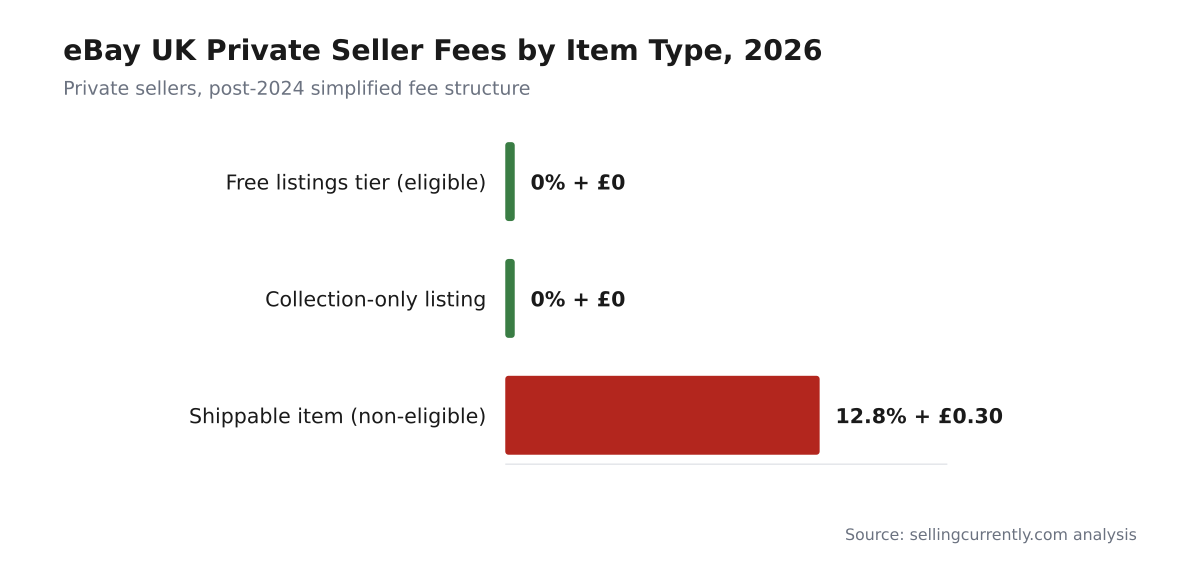
eBay UK Fee Structure for Private Sellers
For a UK-resident private seller, the sale itself is free:
- Final value fee — none, in all categories except motors
- Regulatory operating fee — none
- Payment processing — none charged separately
You receive the full amount the buyer paid for the item, into the bank account linked during registration.
Three things still cost money. Listing beyond your monthly free allowance carries an insertion fee. Optional listing upgrades are charged whether or not the item sells. And delivering to an overseas address attracts fees — the free-selling arrangement covers domestic sales.
Who Still Pays 12.8% + £0.30?
The 12.8% final value fee plus a £0.30 per-order regulatory operating fee is real, but it is not the private-seller rate. It applies to business sellers, and to private sellers who are not UK residents selling into the UK market. If you have read that number elsewhere and assumed it applied to you as a UK private seller, that is the single most common misreading of eBay's current UK rate card.
Motors listings (Cars, Motorcycles & Vehicles) sit outside the free arrangement entirely and are charged on their own basis.
What You Actually Keep
For a UK-resident private seller on a domestic sale, the arithmetic is short.
Example breakdown:
- Item price: £20
- Postage charged to buyer: £5
- Total sale amount: £25
- Final value fee: £0
- Regulatory operating fee: £0
- Total fees: £0
- You receive: £25
The same £20 item sold by a business seller or a non-UK-resident private seller is charged on the total amount the buyer pays — item price plus the postage you charged — so the fee base would be £25, not £20. That is worth knowing if you are deciding whether to register as a business seller: the fee lands on postage as well as goods.
Where fees do reach a UK private seller, they are the listing-side and delivery-side ones covered below, not a cut of the sale.
Is There Really a “No Final Value Fee” for Private Sellers?
Yes — for UK-based private sellers this is the standing arrangement, not a promotional window. eBay UK states plainly that it is now free for UK-based private sellers to sell across its categories, motors excluded, with no final value fees and no regulatory operating fees when items sell.
The qualifications that matter:
- You must be UK-resident. Private sellers based outside the UK pay the 12.8% + £0.30 structure.
- Motors are excluded. Cars, Motorcycles & Vehicles listings are charged separately.
- Volume, upgrades and overseas delivery still cost. Fees apply if you list more than 300 items in a month, add optional listing upgrades, or deliver to an overseas address.
- Business sellers are a different rate card entirely. If eBay classifies your activity as trading, you move onto business-seller fees — and HMRC may take the same view of your tax position.
Note also that eBay updated its UK fees from 12 February 2026, including an adjustment to the per-order final value fee on orders above £10. Those changes sit on the business-seller side; the free arrangement for UK private sellers was not affected.
Free Listings: What You Get
Private sellers in the UK receive 300 free listings per month, or 400 with an eBay Shop subscription. This includes:
- Auction-style listings
- Fixed-price (Buy It Now) listings
- Listings with up to 12 photos
Beyond the allowance, each additional listing costs £0.35 to insert, charged when you create the listing regardless of whether it sells. For most private sellers the allowance is not a real constraint — 300 listings a month is well past the point where HMRC would start asking whether you are trading rather than clearing out.
Relisting unsold items does not count against your free allowance if the item didn’t sell in the previous listing cycle.
Additional Fees and Upgrades
eBay offers optional paid upgrades to increase visibility:
- Subtitle — £1.50 per listing
- Bold title — £2 per listing
- Promoted listings — Variable cost based on ad rate you set (typically 2%–20% of sale price, charged only if item sells via promoted placement)
Most private sellers do not use these features. Free listings with clear photos and accurate titles perform adequately in search without paid boosts.
When eBay Pays You
eBay processes payouts on a rolling basis under managed payments. Funds are typically available 2 business days after the buyer’s payment clears, unless:
- Your account is new (first few sales may be held for up to 30 days)
- The item requires tracked delivery and tracking hasn’t updated
- The buyer opens a dispute or return request
Payouts go directly to the bank account you linked during registration. There is no option to hold funds in an eBay wallet for UK sellers under managed payments.
How the Structure Got Here
Before 2022, eBay UK charged a 10% final value fee plus a separate PayPal fee (typically 2.9% + £0.30), for a combined effective cost around 13%–14%. The 2022 move to managed payments consolidated that into a single 12.8% + £0.30 charge.
The change that matters for private sellers came later: eBay UK removed selling fees for UK-based private sellers entirely, first in clothing categories and subsequently across the board, motors excepted. The competitive logic is not subtle — Vinted charges sellers nothing, and eBay was losing casual second-hand supply to it.
Example comparison for a £50 sale by a UK-resident private seller:
- Old model (2021) — 10% eBay fee (£5) + PayPal fee (£1.75) = £6.75 total
- Managed payments (2022) — 12.8% (£6.40) + £0.30 = £6.70 total
- Current (2026) — £0
If you are working from a margin model built before this change, it is now wrong in your favour.
Tax Implications for Private Sellers
eBay does not withhold tax from seller payouts. If you’re selling personal items occasionally, you typically don’t owe income tax or capital gains tax under UK law—this is considered “disposal of personal possessions.”
However, if you’re trading regularly or buying items specifically to resell, HMRC may classify you as a trader. In that case:
- Register as self-employed and file a Self Assessment tax return
- Register for VAT if your annual sales exceed £90,000 (2026 threshold)
- Keep records of all income and expenses
covers UK tax obligations in detail.
How eBay Fees Compare to Other Platforms
For a £30 item with £3 postage:
- eBay UK (UK-resident private seller) — You keep £33. No final value fee, no per-order fee
- Vinted — You keep £30. Buyer pays separate protection fee
- Depop — You keep £29.70 after 10% fee on £33 total
- Facebook Marketplace — You keep £30. No fees for private sales
eBay’s fees are higher than Vinted and Facebook Marketplace but lower than Depop for most categories. eBay’s advantage is audience size and built-in buyer trust, especially for electronics, collectibles, and higher-value items.
When eBay’s Fees Are Worth Paying
eBay makes sense when:
- Selling items over £50, where eBay’s larger buyer base beats the reach of a zero-fee local platform — and now costs a UK private seller nothing to access
- Listing collectibles, vintage items, or niche products where eBay’s search volume drives discovery
- You need buyer protection mechanisms and dispute resolution infrastructure
For low-value clothing or local-only sales, platforms like Vinted or Facebook Marketplace may deliver better net returns due to lower or zero fees.
Summary
UK-based private sellers pay no final value fee and no regulatory operating fee on eBay in 2026, across all categories except motors. You get 300 free listings per month (400 with an eBay Shop), and fees still apply beyond that allowance, on optional listing upgrades, and on overseas deliveries. Payouts arrive within 2 business days after sale. The 12.8% + £0.30 structure is what business sellers and non-UK-resident private sellers pay.
On take-home per sale, that puts eBay level with Vinted and Facebook Marketplace for UK private sellers, while keeping a far larger buyer base and established buyer protection — a materially different calculation from the one most fee comparisons still describe.
If you’re selling regularly, compare your net per-item return across platforms—especially for categories where multiple platforms compete for the same buyer demographic.
Related guides
- How to Sell on Gumtree in the UK: A Seller’s Guide for 2026
- How to Sell on Etsy in the UK: Getting Started and Getting Found
- Do You Pay Tax Selling on eBay in the UK? 2026 Rules Explained
- Vinted vs eBay vs Facebook Marketplace: Which Pays More in 2026
- How to Sell on eBay in the UK: Complete Guide for Private Sellers 2026
Constantin R. T.
Independent reseller and platform analyst. Tests every marketplace listed here and tracks fees, payout speed, and policy changes across Europe and the US.