
Platform guides
How to Sell on Amazon in Germany: FBA vs FBM Explained
Amazon Germany: Fee Breakdown on a €25 Sale, FBA vs FBM Amazon Germany: Europe’s Largest Amazon Marketplace Amazon.de is the largest Amazon marketplace in Europe, with over 50 million active customers and accounting for roughly 30% of all e-commerce sales … Read more
Amazon Germany: Europe’s Largest Amazon Marketplace
Amazon.de is the largest Amazon marketplace in Europe, with over 50 million active customers and accounting for roughly 30% of all e-commerce sales in Germany. For sellers, this represents access to one of the wealthiest and most active online shopping markets in the world. Unlike classifieds platforms or secondhand marketplaces, Amazon is designed for new products, professional sellers, and scalable operations.
Selling on Amazon Germany requires choosing between two fulfillment models: FBA (Fulfillment by Amazon) and FBM (Fulfillment by Merchant). This decision affects your costs, operational complexity, eligibility for Amazon Prime, and customer experience. Understanding the trade-offs is essential before committing to either model.
Setting Up an Amazon Seller Account in Germany
Go to services.amazon.de and click “Jetzt verkaufen” (Sell now) to begin registration. You will need a valid email address, European bank account (IBAN), business address, and phone number. Amazon requires identity verification for all sellers, which means uploading a government-issued ID (passport or national ID card) and proof of address (utility bill or bank statement dated within the last 90 days).
Most sellers register for a Professional Seller account, which costs €39 per month and allows unlimited listings with access to advanced selling tools. The Individual Seller account is free but charges €0.99 per item sold and restricts access to features like bulk uploads and advertising. For anyone planning to sell more than 40 items per month, the Professional account is more cost-effective.
If you are based outside Germany, you can still sell on Amazon.de, but you must provide a German VAT registration number or use Amazon’s VAT Services to collect and remit VAT on your behalf. Non-EU sellers face additional compliance requirements including fiscal representation in Germany.
FBA vs FBM: What’s the Difference?
The core decision when selling on Amazon Germany is how you handle fulfillment:
FBA (Fulfillment by Amazon): You send inventory to Amazon’s warehouses in Germany. Amazon stores your products, picks, packs, and ships orders when they sell, and handles customer service and returns. Your listings display the Prime badge, making them eligible for free next-day delivery to Prime members.
FBM (Fulfillment by Merchant): You store inventory yourself and ship orders directly to customers when they purchase. You handle customer service and returns. Your listings do not carry the Prime badge unless you meet strict performance criteria and are accepted into Seller Fulfilled Prime (a program with high requirements that most sellers do not qualify for).
FBA listings consistently outsell FBM listings for the same product because German buyers strongly prefer Prime-eligible items. Around 70% of Amazon.de customers are Prime members, and they filter heavily for Prime-eligible products. If your product is not Prime-eligible, you lose access to the majority of the buyer pool.
Amazon Germany Fees: FBA
FBA fees in Germany consist of several components:
- Referral fee: A percentage of the sale price, typically 8–15% depending on category. Electronics and fashion are usually 15%, books are 15%, home goods are 15%.
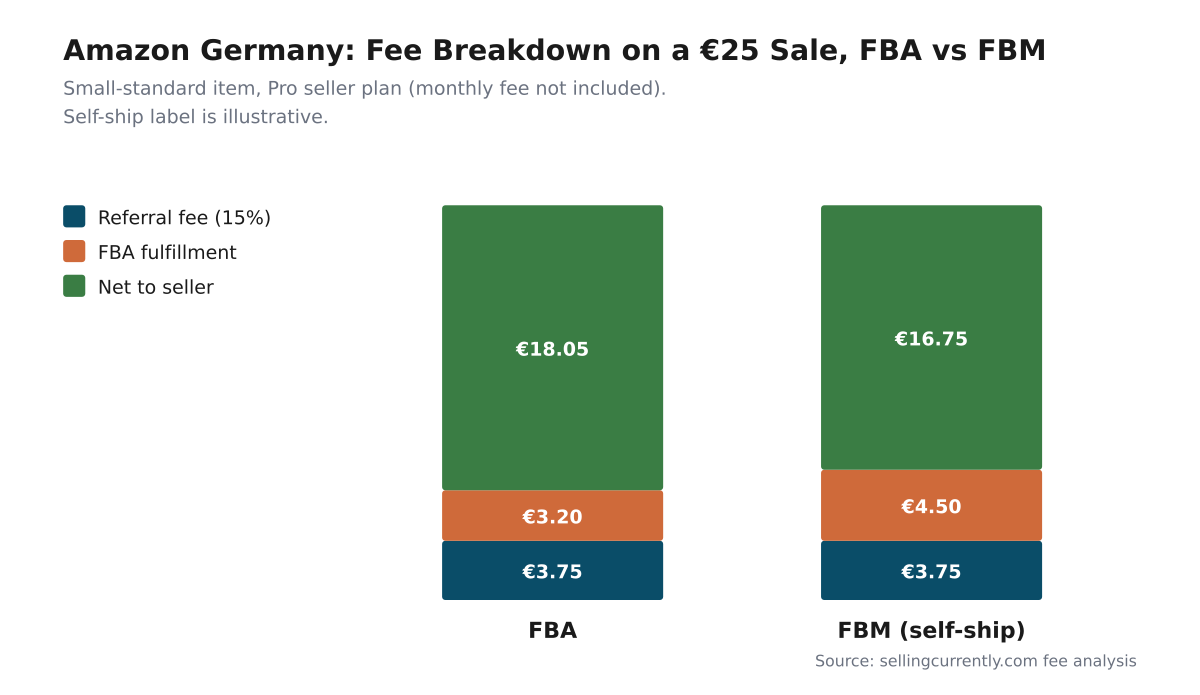
- FBA fulfillment fee: Charged per unit based on size and weight. A small standard item (under 400g, fits in a 35×25×12cm box) costs around €3.31 per unit. Larger or heavier items cost more. Amazon provides a fee calculator on services.amazon.de.
- Storage fees: Charged monthly based on cubic meters of space your inventory occupies in Amazon’s warehouses. Standard storage is around €26 per cubic meter per month (January–September) and €36 per cubic meter during peak season (October–December). Long-term storage fees apply to items stored for over 365 days.
- Removal or disposal fees: If you need to withdraw unsold inventory from FBA warehouses, Amazon charges €0.50–€0.60 per unit to return items to you, or €0.15–€0.30 per unit to dispose of them.
For a typical small item selling for €20, expect to pay around €6–€8 in combined Amazon fees (referral + FBA fulfillment), leaving you with €12–€14 before product cost, shipping to FBA, and VAT.
Amazon Germany Fees: FBM
FBM sellers pay only the referral fee (8–15% of sale price) and the Professional Seller subscription (€39/month). You avoid FBA fulfillment and storage fees entirely, but you must cover your own shipping costs, packaging materials, and labor to process orders.
For low-margin products or items that are expensive to ship, FBM can be more profitable than FBA. However, FBM listings rank lower in search results and convert at significantly lower rates due to the absence of the Prime badge. Most successful sellers on Amazon Germany use FBA unless their products are oversized, low-priced, or fragile in ways that make FBA uneconomical.
When to Use FBA
FBA makes sense when:
- Your product sells for more than €15 and has sufficient margin to absorb FBA fees while remaining profitable.
- You sell items with predictable demand and reasonable turnover — fast-moving inventory minimizes storage fees.
- You want to reach Prime members, who represent the majority of Amazon.de buyers.
- You value time and want Amazon to handle logistics, customer service, and returns.
- You plan to scale — FBA allows you to grow without proportionally increasing operational workload.
FBA is the dominant model among professional Amazon sellers in Germany. The Prime badge alone increases conversion rates by 2–3 times compared to equivalent FBM listings.
When to Use FBM
FBM makes sense when:
- Your products are large, heavy, or oversized, making FBA fulfillment fees prohibitively expensive.
- You sell low-priced items (under €10) where FBA fees exceed your margin.
- You have existing warehouse space and fulfillment infrastructure that makes self-shipping more economical than FBA.
- You sell handmade, custom, or made-to-order items that cannot be sent to FBA in advance.
- You want to maintain direct control over packaging, branding, and customer communication.
Some sellers use a hybrid model: FBA for best-selling SKUs and FBM for slower-moving or oversized items. Amazon allows you to use both fulfillment methods within the same seller account.
Shipping Inventory to Amazon FBA Germany
If you choose FBA, you must send inventory to Amazon’s fulfillment centers in Germany. The process is:
- Create a shipment plan in Seller Central, specifying which products and quantities you are sending.
- Label each unit with an Amazon barcode (FNSKU). Amazon provides printable labels or you can pay Amazon to label products for you (€0.30 per unit).
- Pack and ship the inventory to the fulfillment center Amazon designates. Amazon may split shipments across multiple warehouses to optimize their logistics network.
- Amazon receives and processes your shipment, making the inventory available for sale once checked in.
Shipping costs to FBA warehouses are your responsibility. For sellers outside Germany, this can be expensive — factor international freight costs into your pricing and margin calculations.
VAT and Tax Compliance for Amazon Germany Sellers
All sellers on Amazon.de must collect German VAT (Mehrwertsteuer) on sales to German customers. The standard VAT rate in Germany is 19%, with a reduced rate of 7% for certain categories like books and food.
If you are based in Germany, you must register for VAT and file regular VAT returns with the Finanzamt (German tax office). If you are based elsewhere in the EU, distance selling thresholds apply — once you exceed €10,000 in annual sales to German customers, you must register for German VAT.
Non-EU sellers using FBA in Germany must register for German VAT regardless of sales volume, because storing inventory in German FBA warehouses creates a taxable presence in Germany. Amazon provides VAT Services to handle registration and filing on your behalf for a fee, which simplifies compliance but costs around €400 per year.
Product Restrictions and Compliance
Amazon Germany enforces strict rules on what can be sold. Certain categories require approval before you can list products, including:
- Grocery and gourmet food (requires food safety certification)
- Beauty and personal care (requires proof of compliance with EU cosmetics regulations)
- Toys and children’s products (requires CE marking and safety certifications)
- Electronics (requires CE marking and DoC – Declaration of Conformity)
Selling products that do not meet EU safety and labeling requirements can result in listings being removed, funds being withheld, or your account being suspended. Ensure all products comply with German and EU regulations before listing.
Should You Sell on Amazon Germany in 2026?
Amazon Germany offers access to Europe’s largest online marketplace, but it is highly competitive and operationally complex compared to classifieds or secondhand platforms. Success requires products with sufficient margin to absorb Amazon’s fees, compliance with German VAT and product safety regulations, and either the capital to use FBA or the infrastructure to compete via FBM.
For professional sellers with products that fit Amazon’s ecosystem — new goods, predictable demand, margins above 30% — Amazon.de can generate significant revenue. For casual sellers or those with low-margin products, classifieds platforms or niche marketplaces are more viable. If you choose to sell on Amazon Germany, start with FBA for a small selection of SKUs, test demand and profitability, and scale based on what the data shows.
Related guides
- Amazon FBA Germany Fees 2026: What You Actually Pay
- How to Sell on Kleinanzeigen in Germany: Tips for New Sellers
- Amazon Seller Fees in Europe 2026: FBA Costs Country by Country
- Do You Pay Tax Selling Online in Germany? What the Law Says 2026
- Best Online Marketplaces in Germany 2026
- How to Sell on Amazon in the UK: FBA vs FBM for New Sellers 2026
Constantin R. T.
Independent reseller and platform analyst. Tests every marketplace listed here and tracks fees, payout speed, and policy changes across Europe and the US.